



A skincare industry insider explains what really causes crepey skin, why body skin behaves differently than facial skin, and the two biggest lessons learned from years of clinical testing.
If you've been following SKIN AT WORK for a while, you already know that I have spent the better part of 35 years formulating skincare, reading clinical studies, rubbing way too many creams on way too many people, and generally trying to separate skincare science from skincare marketing.
Here's something you might not know.
It's a little-known fact, but while I was the VP for Cindy Crawford's Meaningful Beauty, I was also the VP of Crepe Erase.
Yep. The one with Jane Seymour.
Sidebar: Of all the celebrities I've worked with over the years, Jane is hands-down one of the kindest and most genuine people I've ever met.
At that company I was actually responsible for eight different skincare brands, including Perricone MD and IT Cosmetics' Bye Bye Foundation.
It was exhausting.
But I also learned an enormous amount about one of the most frustrating concerns in skincare: crepey body skin.
So...
Does Crepe Erase work?
Yes. It actually does.
We conducted countless clinical studies to validate its performance.
Does it work on everyone? Not always.
And honestly? That's true of every skincare product ever made. Whether it's for your face or your body, biology always beats marketing. Different people have different genetics, lifestyles, sun damage histories, hormones and expectations.
What I did discover, however, were a few universal truths.
After watching years of before-and-after photography, studying clinical data, and yes... rubbing an embarrassing number of forearms during testing (strictly platonically, of course 😆), certain patterns became impossible to ignore.
Before we get to those, let's first understand what's actually happening underneath the skin.
What Actually Causes Crepey Skin?
Most people think crepey skin is simply "dry skin."
That's part of it, but not the whole story.
Dryness makes it look worse, but crepey skin is really the result of several physiological changes happening at the same time.
Collagen production slows
Beginning in our late twenties and accelerating after menopause, our skin gradually produces less collagen and elastin.
Collagen provides firmness.
Elastin provides bounce.
When both decline, skin becomes thinner and less resilient.
The moisture barrier weakens
As we age, our skin naturally produces fewer lipids like ceramides, cholesterol and fatty acids.
These are the ingredients that keep water locked inside the skin.
When they're depleted, moisture escapes more easily, leaving skin looking papery and wrinkled.
Cell turnover slows dramatically
When we're young, fresh skin cells reach the surface roughly every month.
Later in life, that process slows considerably.
Dry cells accumulate on top of the skin, creating roughness and exaggerating every fine line.
Sun damage compounds everything
Ultraviolet light breaks down collagen for years before you can even see it happening.
Many people think crepey skin suddenly appears in their fifties.
In reality, much of the damage began decades earlier.
It's simply taking that long to show itself.
Why Body Skin Is Different Than Face Skin
One mistake I see constantly is people assuming body skincare should work exactly like facial skincare.
It doesn't.
Body skin is a completely different animal.
First, the skin on your arms, legs and knees is naturally thicker than facial skin.
That sounds like a good thing, but it also means active ingredients don't penetrate as easily.
Second, body skin contains fewer oil glands than facial skin.
That's why your cheeks might become shiny by lunchtime while your forearms look like the Sahara Desert by dinner.
Third, the body experiences much more mechanical stress.
Your clothing rubs against it all day.
You lean on your elbows.
Your knees bend thousands of times.
Your hands are washed constantly.
All of that friction accelerates barrier damage.
Finally—and this is the big one—most people simply don't apply enough product.
We'll happily spend $200 on a one-ounce facial serum.
But when it comes to our entire body, suddenly we expect a tiny dab of lotion to do miracles.
Unfortunately, body skincare is often a game of coverage as much as chemistry.
Crepey Skin Truth #1
Exfoliation Is More Important Than Your Cream
This was probably the biggest surprise I learned during my years running Crepe Erase.
People obsess over finding the perfect anti-crepe cream.
But in our clinical studies, I could often improve results by roughly 50% simply by having participants properly exfoliate before applying their moisturizer.
Think about painting a wall.
You wouldn't paint over peeling paint and expect a smooth finish.
Skin works exactly the same way.
Those accumulated dead skin cells create tiny ridges that catch light and exaggerate wrinkles.
Even worse, dead skin doesn't absorb moisture particularly well.
Instead, expensive creams simply sit on top, making skin feel greasy without delivering their full benefit.
That's why I recommend spending at least 30 seconds exfoliating each body section, once or twice a week.
Thirty seconds on the front of your upper arm.
Thirty seconds on the back.
Thirty seconds on your forearm.
Thirty seconds on the backs of your hands.
You don't need to scrub aggressively.
In fact, please don't.
Let the exfoliating particles—or better yet, gentle acids—do the work.
Aggressive scrubbing can create tiny micro-tears that weaken the skin barrier, which is exactly the opposite of what crepey skin needs.
Right now I'm personally loving Nécessaire's Body Exfoliator.

Partly because I genuinely like the formula.
Partly because I absolutely love eucalyptus.
We have eucalyptus trees throughout our LA neighborhood, so every morning walk to the gym smells like I'm checking into a luxury spa.
Crepey Skin Truth #2
The Real Heroes Aren't Usually the Fancy Firming Ingredients
Okay...
This one may get me into a little trouble.
When people shop for body creams, they immediately look for peptides, stem cells, exotic algae extracts and impressive-sounding marketing language.
Those ingredients certainly have value and a well balanced formula will contain them at meaningful percentages. (That's a topic for another day)
But after years of watching formulations succeed—and fail—the ingredients doing the heavy lifting are usually much less glamorous.
The butters.
Cocoa butter.
Shea butter.
Mango butter.
Rich plant oils.
Not tiny sprinkle-in amounts either.
A lot of them.
Every time we were asked to "value engineer" formulas by reducing the butter content to save manufacturing costs, the performance dropped.
Not a little.
A lot.
That's because these rich emollients dramatically improve the appearance of crepey skin by restoring flexibility, reducing moisture loss and softening rough texture.
They're not flashy.
They're just incredibly effective.
Here's my ingredient deck trick.
If you're shopping for a body butter, flip it over.
Read the ingredient list.
If cocoa butter, shea butter or mango butter appear within roughly the first ten ingredients, you're probably getting meaningful amounts.
If they're hanging out near the bottom of the list...
They're mostly there for marketing.
Buyer beware of those crafty marketers.
My Current Routine
These days, one of my favorite affordable body creams comes from Andalou Naturals.
Their body butter performs far above its price point, which means I don't feel guilty absolutely slathering it on.

Because let's be honest...
Body skincare works a lot better when you actually use enough of it.
My Secret Weapon
When my forearms, biceps or the tops of my knees start looking particularly crepey, I reach for something that technically wasn't even designed for the body.
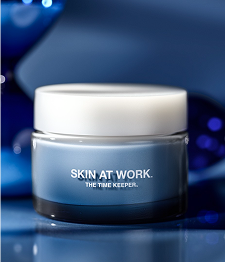
THE TIME KEEPER.
I simply mix a pea-sized amount with a little water in my hands so it spreads like a lightweight body lotion.
It goes much farther that way, and I can easily work it over larger areas.
Why does it work so well?
Because it addresses several causes of crepey skin at once.
It contains clinically meaningful peptides to support firmer-looking skin.
It contains ceramides, cholesterol and fatty acids to strengthen the moisture barrier.
And it contains multiple hydration technologies that help skin appear smoother, plumper and healthier almost immediately.
That's one of the philosophies we've always believed in at SKIN AT WORK.
Don't solve one problem.
Solve several simultaneously.
The Next Chapter for SKIN AT WORK
Here's the exciting part.
For years, many of you have asked why we only apply this philosophy to facial skincare.
This October, we're launching a body version of THE TIME KEEPER, specifically engineered for larger surface areas while keeping the same SKIN AT WORK philosophy you've come to expect: clinically studied ingredient levels, transparent formulations, serious hydration, barrier repair and targeted actives that actually make sense together.
Until then?
Don't neglect your body.
Exfoliate consistently.
Don't be afraid of rich butters.
Read ingredient decks instead of marketing headlines.
Here's to your best (Body) Skin!
