


The Truth About One of Skincare's Most Misunderstood Products
Do you remember when we were kids and our skincare routine consisted of Sea Breeze, Clearasil and Noxzema? We were burning our skin with astringents and acne solutions and then applying a cold cream on top of it to soothe our skin. Oh and you guessed it, that same cold cream would re-clog our young pores so that we were forced to use more astringents and acne products. A vicious cycle.
I remember being so traumatized by cystic acne. You know, the kind that won't surface and just makes a Close Encounters red mountain on your skin that just won't go away? Now the irony is that my skin is very dry at 56 years old. Hormones are a crazy thing. In a full-circle moment, I am now on testosterone replacement therapy which occasionally causes breakouts. Cruel, cruel world. LOL.
Back then, toners were the thing, but you don't hear about them nearly as much anymore. And honestly, there is a reason for that. They absolutely have a purpose, but they aren't the miracle step they were once marketed to be. So should you still be using one?
Let's talk about it.
What Was a Toner Originally Designed to Do?
If you grew up in the 70s, 80s or 90s, chances are you had a bottle of toner sitting beside the sink.
For many people, that toner was from Clinique. Their famous three-step system—cleanse, clarify and moisturize—became almost a rite of passage. Their Clarifying Lotions helped define what an entire generation thought skincare should look like.
Then there were the drugstore classics.
Sea Breeze.
Clean & Clear.
Oxy.
Stridex.
The stronger they stung, the more convinced we were they were working.
Somewhere along the way, we collectively decided that if your eyes weren't watering slightly, your skin probably wasn't getting clean enough.
Thinking about it makes me chuckle.
The original definition of a toner wasn't wrong. It simply reflected the skincare products of the time.
Historically, toners were designed to:
-
Remove leftover cleanser residue
-
Remove traces of makeup
-
Restore skin's pH after using highly alkaline soaps
-
Temporarily remove excess oil
-
Leave skin feeling "tight and clean"
The problem wasn't the idea of a toner.
It was the products we were using before it.
The Great pH Problem
Here's something most people don't realize.
Many facial cleansers decades ago weren't really facial cleansers.
They were soap.
Traditional soaps can have a pH around 9 or 10, while healthy skin naturally sits closer to 4.7-5.5.
When skin becomes too alkaline, the barrier temporarily struggles to function properly. Water escapes more easily, irritation increases and your skin has to work overtime to restore itself.
A toner helped bring that pH back down.
So in those days, toners actually made a lot of sense.
Fast forward to today.
Modern skincare chemistry has come a very long way.
Most professionally formulated cleansers today are already pH balanced. They cleanse effectively while respecting your skin barrier instead of disrupting it.
Which means one of the original reasons for using a toner has quietly disappeared.
So...Do You Actually Need a Toner Today?
Sometimes.
Most of the time?
Probably not.
Like many skincare products, the answer depends entirely on what you're trying to accomplish.
Here are a few situations where a toner can still be genuinely useful.
You use an old-school or highly alkaline cleanser
If you're washing with bar soap or a cleanser that leaves your face feeling squeaky clean (which usually means stripped), a toner can help restore your skin's natural acidity.
That said, I'd probably recommend changing cleansers before adding another product.
Fix the problem instead of treating the symptom.
You use prescription acne medications
Prescription retinoids, benzoyl peroxide or certain acne routines can temporarily disrupt the skin barrier.
Some modern hydrating toners containing ingredients like glycerin, panthenol, ectoin or beta-glucan can provide an extra layer of hydration before applying treatment products.
Notice I said hydrating toner.
Not alcohol in a fancy bottle.
Those are two very different products.
You're using multiple exfoliating acids
If you're regularly layering glycolic acid, salicylic acid, mandelic acid or other low-pH exfoliants, some people find a calming toner helps reduce irritation afterward.
Although again...
I'd first ask whether your routine has become more complicated than it needs to be.
One of the biggest trends I've seen over my 35 years in skincare is people trying to solve irritation by buying another product, instead of asking why they're irritated in the first place.
You enjoy the ritual
This one is perfectly valid.
Skincare doesn't always have to be purely clinical.
If applying a hydrating toner every evening makes you slow down, relax and enjoy your routine, there's absolutely nothing wrong with that.
Just don't confuse enjoying a ritual with needing one.
Those are very different things.
Who Probably Doesn't Need a Toner?
This list is much longer.
If you're using a modern, pH-balanced skincare routine that already cleanses effectively without stripping your barrier, you're probably already accomplishing everything an old-fashioned toner was designed to do.
That includes most people.
Especially if your cleanser is properly formulated.
What About Cleaning Out Your Pores?
This is probably the biggest misconception I still hear.
"I use toner because it cleans whatever my cleanser missed."
Maybe twenty-five years ago.
Not necessarily today.
A well-formulated cleanser should already remove sunscreen, makeup, pollution, excess oil and daily debris without leaving your skin feeling stripped.
If you feel like your toner is constantly removing dirt after cleansing, that may actually be telling you something about your cleanser.
Or your cleansing technique.
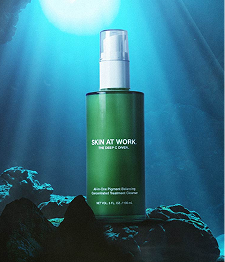
At SKIN AT WORK, THE DEEP C DIVER was specifically formulated to thoroughly cleanse while respecting the skin barrier.
Instead of relying on harsh alcohols that leave your face feeling tight, it uses clinically studied cleansing agents and supporting ingredients that help remove impurities without triggering unnecessary dryness.
Clean skin shouldn't feel punished.
It should simply feel...clean.
"My Toner Controls My Oil."
Or does it?
Here's where things get interesting.
Many traditional toners removed so much oil that skin responded by trying to replace what had just been stripped away.
It's your skin doing exactly what it's designed to do.
Your barrier senses the loss of lipids and moisture and starts compensating.
That compensation can look like...
More oil.
Which often leads people to use even more toner.
Sound familiar?
It's another vicious cycle.
The goal isn't to eliminate every drop of oil.
Healthy skin is supposed to contain oil.
The goal is balance.
A good cleanser removes excess oil without convincing your skin it's living in the Sahara Desert.
The Modern Definition of a Toner
Today's best toners look very different from the sting-in-a-bottle products many of us grew up with.
Many are now essentially lightweight treatment serums.
Some deliver antioxidants.
Others focus on hydration.
Some contain peptides.
Others include soothing ingredients for sensitive skin.
Ironically, many modern toners aren't really toners at all.
They're simply another delivery system for active ingredients.
Which raises a fair question.
If your serum already contains those ingredients...
Do you need another bottle?
Less Really Can Be More
One of the philosophies behind SKIN AT WORK has always been getting the maximum results from the minimum number of products.
Not because we're against skincare routines.
We're against unnecessary skincare routines.
Every product should earn its place.
If a cleanser already cleanses well...
Why buy another product to finish the job?
If your moisturizer already hydrates...
Why add another hydration step unless you truly need it?
If your products are already pH balanced...
Why correct a problem that doesn't exist?
That's not about selling fewer products.
It's about respecting your skin—and your wallet.
The Bottom Line
Toners aren't bad.
They're just no longer universally necessary.
Here's a quick summary guide:
-
Using a pH-balanced cleanser? → Probably don't need one.
-
Using bar soap or harsh cleansers? → Change the cleanser first.
-
Using prescription acne treatments? → A hydrating toner may help.
-
Using heavy acid routines? → A hydrating toner may also help here.
-
Love the ritual? → Enjoy it—but know it's optional.
